
Club Story
Our Founders
In 1988 a group of prominent Nashville business professionals, weary of the planning required to secure a tee time and play a round at other local clubs, collaborated to create The Golf Club of Tennessee. Nashville businessmen Toby Wilt and George Gillett first conceived of building a “fine golf club in or near the city.” After finding a piece of property in rural Cheatham County, the two men invited Bronson Ingram, chairman of Nashville-based Ingram Industries, to join them as founders of a golf-only club that would provide dedicated golfers an excellent course in an exceptionally maintained environment of seclusion and exclusivity, an idea that would become The Golf Club of Tennessee.
Though Gillett left the project after purchasing Vail, Inc. in Colorado, Wilt and Ingram forged ahead, selecting Tom Fazio, one of the era’s top architects, to bring their concept to life. With nearly one thousand acres at his disposal, and marching orders to “design the very best golf course” he was capable of, Fazio went to work “discovering” a masterpiece. Opening for member play in March 1991 the golf course gained instant national recognition, receiving runner-up honors in Golf Digest’s rankings of Best New Private Courses for 1991.
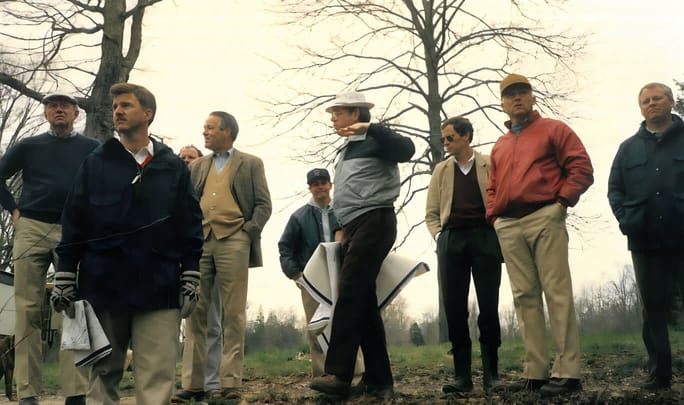
Tom Fazio, Bronson Ingram, Toby Wilt, David Wiley, & Chip Christianson mapping out what would become the Lower Course
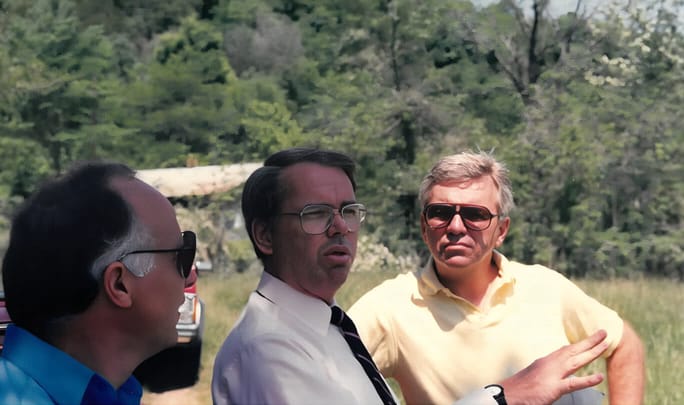
Tom Fazio sharing his vision with Toby Wilt and Jim Caden
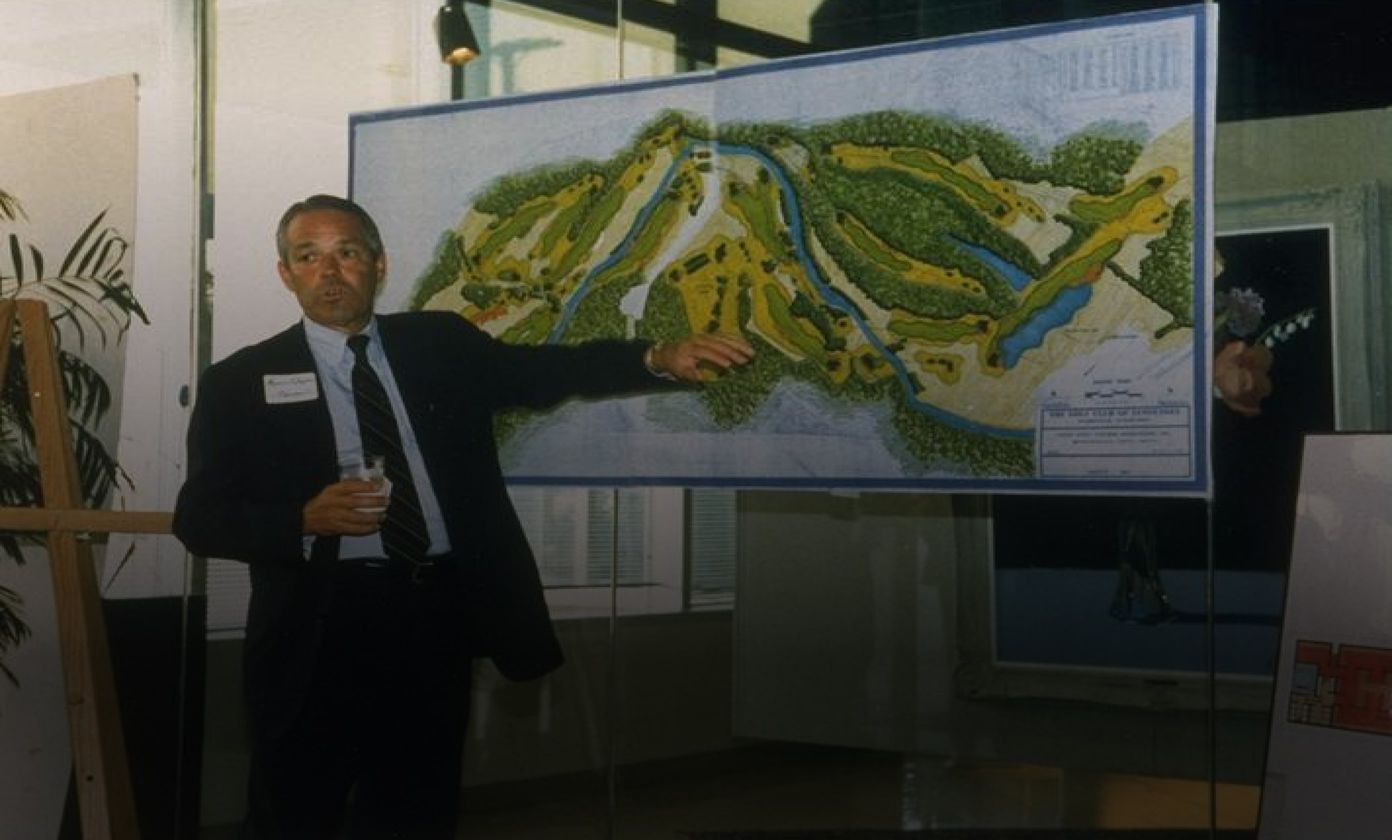
A Fine Golf Club
In its inaugural year (1991), Golf Digest recognized The Golf Club of Tennessee as runner-up for the Best New Private Course in America. It is consistently recognized as one of the top two courses in the state of Tennessee, and was recognized by Golf Week as one of America’s 100 Best Modern Courses. Also in 2006, Golf Digest Index ranked The Golf Club of Tennessee as one of America’s 50 Greatest Golf Retreats. The Golf Club of Tennessee has hosted numerous local, state, national amateur and pro-am events, while always providing enjoyable rounds of golf for members and their guests.
Over the years, The Golf Club of Tennessee has been home to many national tournaments such as The Vinny Pro-Celebrity-Am, and The DICK’S Sporting Goods Collegiate Challenge Cup, and the 2018 U.S. Women’s Amateur Championship
The Club has experienced much growth over the last 30 years; clubhouse renovations, lodging additions, outdoor dining outlets to name a few. The Upper Course made its debut in 2024, our second 18-hole course designed by Gil Hanse offers a breathtaking view and a challenging game. No matter how much it grows, The Club stays true to the founders’ vision and remains a quiet place to escape, unwind, be in good company, and play a little golf.

Vince Gill and Payne Stewart speaking to participants of The Vinny
The Upper Course
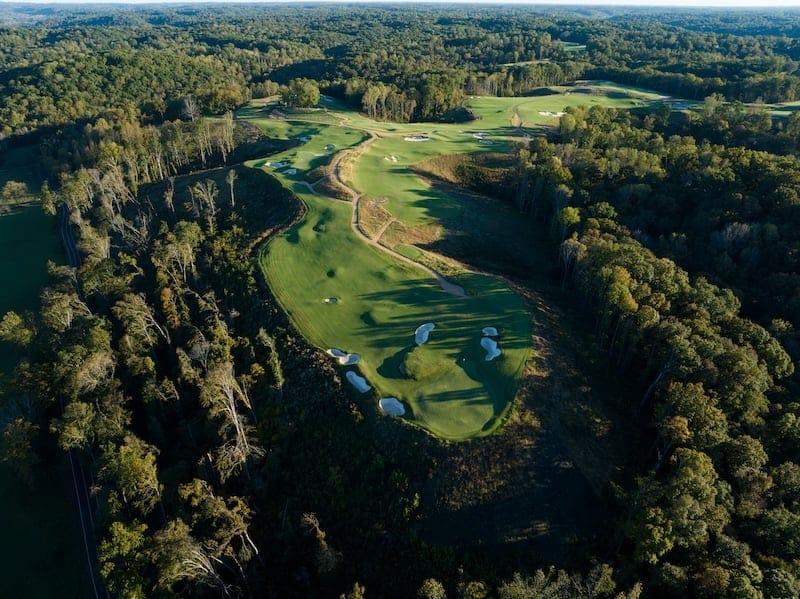
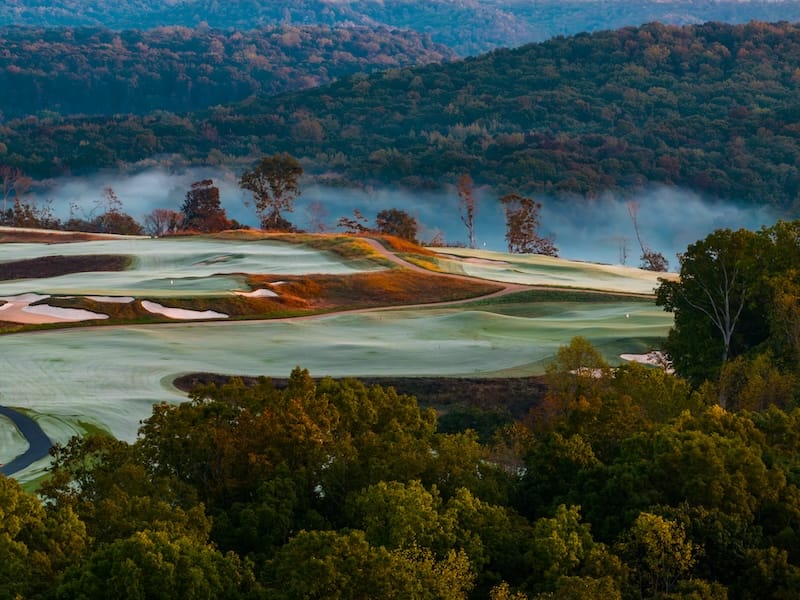
The Golf Club of Tennessee is a premier private golf club featuring two 18-hole golf courses, offering a variety of challenging play. The Upper Course, designed by renowned architect Gil Hanse, opened to golfers in July 2024, offering an exceptional par-72 experience. Perched at an elevation of 722 feet, the course not only delivers panoramic views but also a sense of being on top of the world. The thoughtfully designed layout features a par-3 looking out over the treetops, striking bunkers, and fairways that flow seamlessly through the landscape. You’ll finish your round on a stunning par-5 with sweeping views of the adjacent holes on The Lower Course, all while enjoying the pristine Bermuda greens. The course combines strategic complexity with natural beauty, ensuring a memorable round for players.
History of the Land
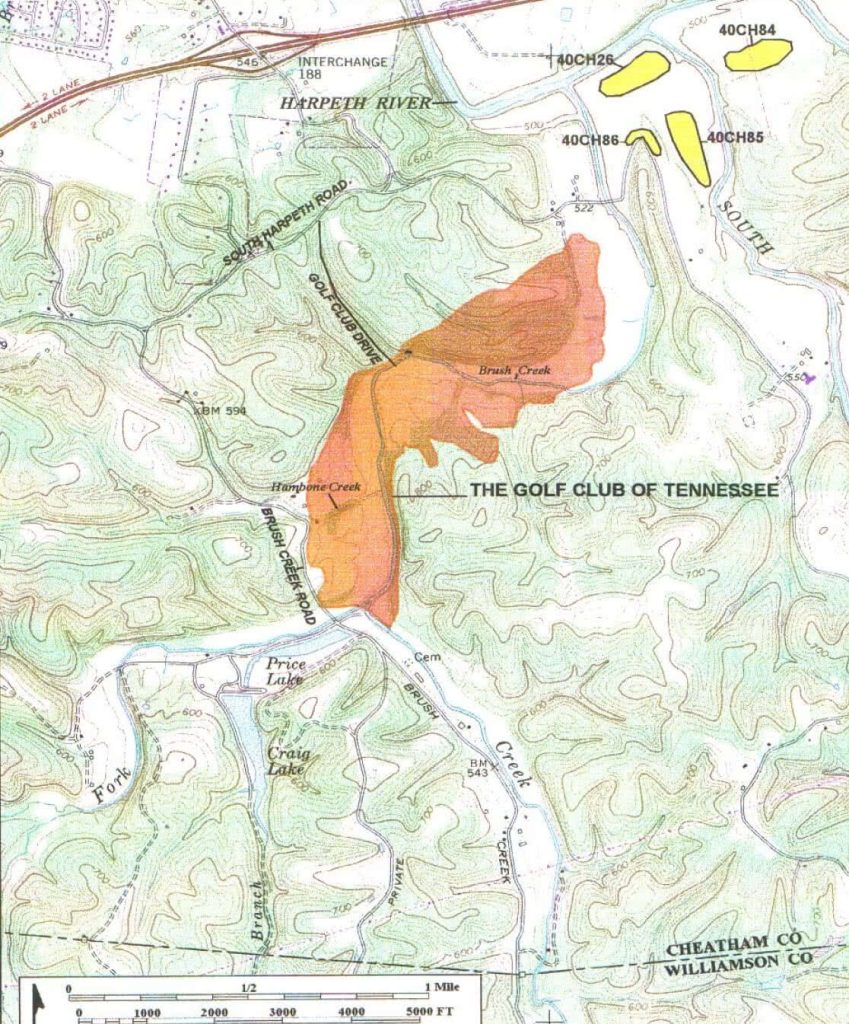
The Golf Club of Tennessee is nestled in the stream valley of Brush Creek, its major tributary Hambone Creek, and several unnamed tributaries. Brush Creek flows north through the course toward the Harpeth River through a fertile valley. Before the land became the property of the Founders of The Club, it served many owners with varied purposes. Several owners left their mark either on the landscape or in the records of the community, while others have faded into obscurity, lost to the historical record. Much of the land was being used to graze horses when it was acquired. The earliest record of the property is found in the Military Warrants granted by the State of North Carolina to veterans of the American Revolution. Three separate warrants grant a total of 947 acres along Brush Creek to three veterans: Hugh Lewis, Jessee Cobb, and Robert Hayes.
In February of 1898 the land was purchased from the Court by G.W. McQuary who was clerk of the Cheatham County Court in 1866, 1870, and 1874. This may explain how McQuary was able to purchase 716 acres for the paltry sum of $253.25. McQuary, a Confederate veteran of the U.S. Civil War, served with McGlung’s Tennessee Light Artillery. McQuary, a speculator of sorts in his own right, was characterized as “a liberal purchaser[s] of land in the 1800s.”
None of these former soldiers appear in any local records and no evidence exists that the three ever came to Middle Tennessee to claim their land. Early owners connected to the property include Willis Beard and John Cooper. There is no evidence to suggest that Beard ever inhabited the land. Cooper, however, is named as the co-tenant with Thomas Ferebee in the 1834 transfer of 230 acres of the property that comprise the north part of The Club. Ferebee, a farmer, had previously obtained 2 adjoining tracts totaling 89 acres in 1833 from Henry Ewing. Upon his death in 1846 Thomas Ferebee passed his share of the property to his spouse Sarah for her lifetime use, then upon her death, to his children. The property that is currently the south part of the club was purchased in 3 tracts totaling 128 acres by Zachariah Jones, also a farmer, from Willis Beard in 1830.
In the early 20th century, during the period when bootlegging, prostitution, and gambling played a significant role in the Kingston Springs economy, the southern part of the land was held by McQuary and P.J. Wyatt. The north part of the land was held by E. F. and Mollie P’Pool and Louis Huggins. The portion of the land containing the cabin, adjacent to Hambone Creek was held by the P’Pools until it was transferred to Huggins in 1928. E. F. (Edmund Franklin) P’Pool was a carpenter and reportedly a man of meager means. The ownership and transfer of 346 acres of land by a relatively poor man on the eve the Great Depression and at the heyday of bootlegging activities in South Cheatham County raises more questions than it answers.
The land of The Golf Club of Tennessee has an interesting and sometimes checkered past. Since the first white settlers arrived in the region, the Brush Creek Valley has been home to war heroes, farmers, speculators, and for a period, bootleggers.
The Ferebee Cemetery
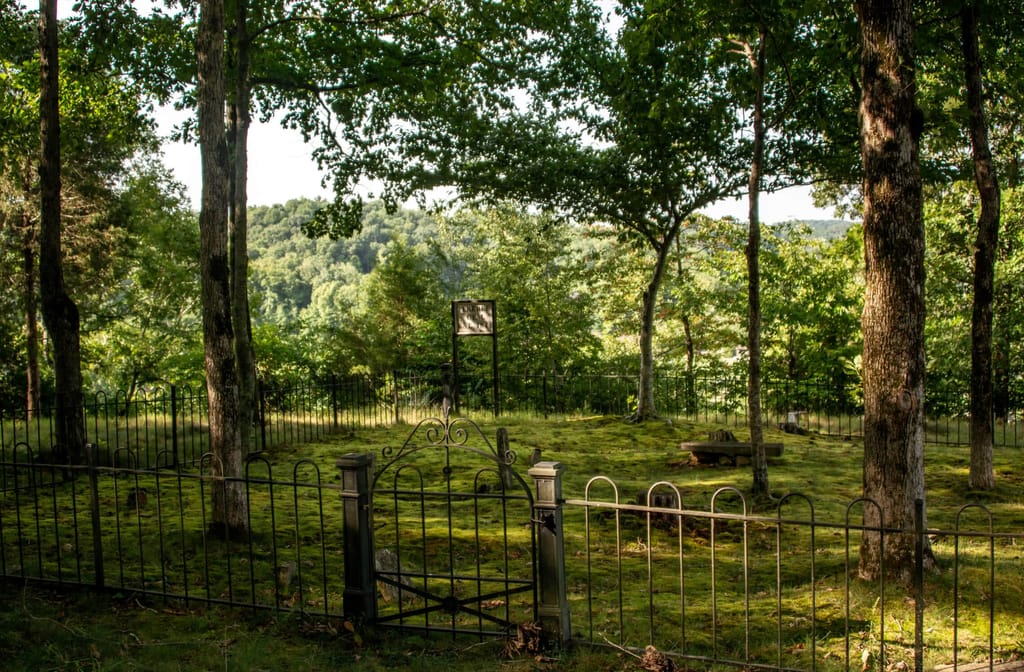
The other remaining evidence of prior human habitation at The Golf Club of Tennessee is the Ferebee Cemetery. The cemetery is located on a bluff .6 miles west of the mouth of the west fork of Brush Creek between the third and fourth holes. Commanding a beautiful, panoramic view of the course, the cemetery is the final resting place of several of the property’s owners and their families. There are four marked and several unmarked graves within the fenced confines of the cemetery. There is one marked grave approximately 100 feet north of the enclosed area next to the cart path and numerous unmarked graves outside the fence. Many of the unmarked graves are located in the woods on the opposite side of cart path from the enclosed cemetery. Their location, away from the marked graves and the panoramic view from the bluff indicate that they are likely African-American slave burials.
The cemetery is named for its earliest marked burial, that of Thomas Ferebee. Thomas Ferebee, identified on page six as a former owner of part of The Club’s property, resided on and farmed 319 acres along Brush Creek with his wife Sarah (Sally), a native of Virginia. The Ferebee’s moved from Norfolk, VA to Nashville in 1819 with their daughter V. A. The inscription on Thomas Ferebee’s headstone reads, “Thos Ferebee b. 27 Feb 1789 d. 4 Aug 1846.” A second Ferebee grave is also located in the cemetery. This is an infant’s burial site marked, “Mary B. Daughter of R & E. S. Ferebee b. January 28, 1859 d. February 6, 1859.” Mary’s parents, R (Rufus) and E. S. were the son and daughter-in-law of Thomas Ferebee. No other marked Ferebee burials were found. Also buried in the Ferebee Cemetery are the remains of M. W. Dunn. Her inscription, some of which is not legible, reads, “M. W. Dunn wife of T. M. Dunn b. November 10, 1823 d. July 3, 1871.” T. M. (Thomas M.) Dunn was the son of Samuel H. Dunn, an early settler in the area, farmer, leading citizen, and member of the Christian Church.
In February of 1898 the land was purchased from the Court by G.W. McQuary who was clerk of the Cheatham County Court in 1866, 1870, and 1874. This may explain how McQuary was able to purchase 716 acres for the paltry sum of $253.25. McQuary, a Confederate veteran of the U.S. Civil War, served with McGlung’s Tennessee Light Artillery. McQuary, a speculator of sorts in his own right, was characterized as “a liberal purchaser[s] of land in the 1800s.”
There is one grave within the confines of the marked cemetery whose inscription appears in the Tombstone Records of Cheatham County, Tennessee, however, the headstone is no longer legible. This is the child’s grave of Thomas Moore. His inscription reportedly read, “Thomas Moore son of M. L. & V. A. Moore b. June 1, 1871 d. December 25, 1873.” V. A. Moore was the daughter of Thomas Ferebee. M. L. Moore served as an officer in the Confederate Army and died in Kingston Springs in 1925 at the age of eighty-three.
The final marked grave inside the fenced area is that of Ida Akin. Her inscription reads, “IDA daut (daughter) of AB & J Akin b. November 28, 1864 d. July 3, 1865 Whos all of life’s rosy blushed in dawn & passed away.” No further information is available about the Akin family.
The sole marked grave outside the confines of the fenced cemetery is resting place of William Ellison. His headstone reads, “Wm. Ellison b. July 24, 1796 d. August 9, 1863. Rest soldier rest thy warfare o’re, Sleep the sleep that knows no breakin- Dream of battlefields no more. Days of danger, nights of waking.” The inscription on Ellison’s headstone refers to his service in the U. S. Army during the War of 1812. Sometime between the ages of fourteen and sixteen, William Ellison soldiered. Ellison married Anna (Ann) Tennison in 1821 and resided in the area until his death. Ellison’s widow lived in the region as late as 1878. Deed records do not show Ellison ever owning any of the property associated with The Golf Club of Tennessee.
The Cabin
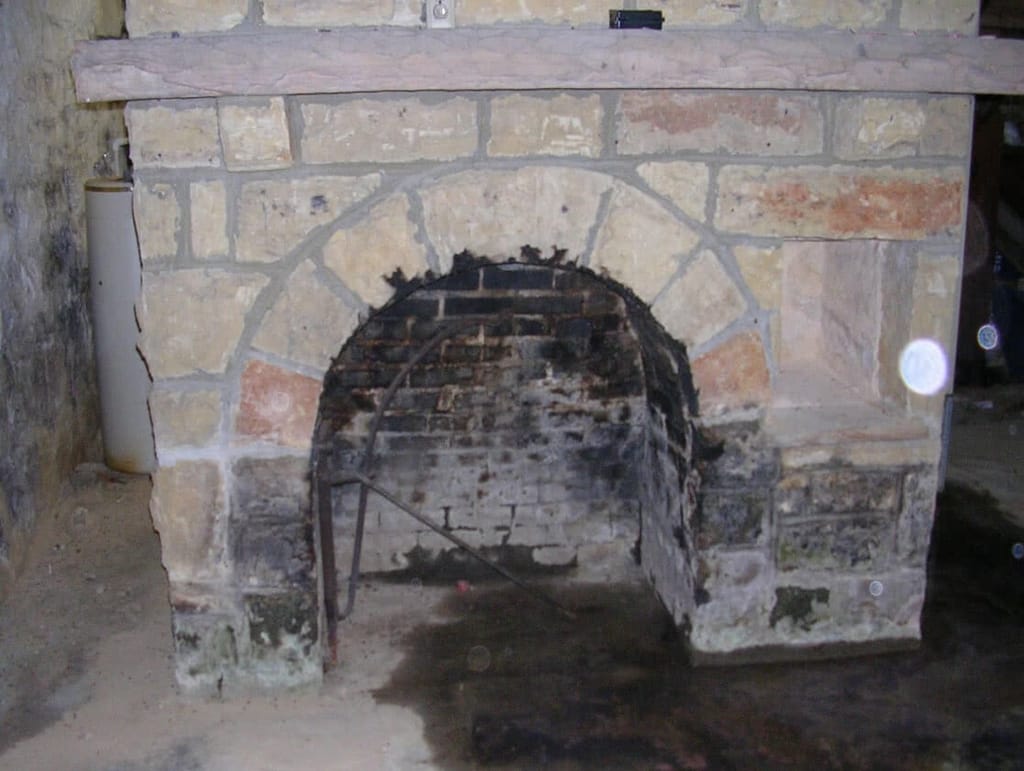
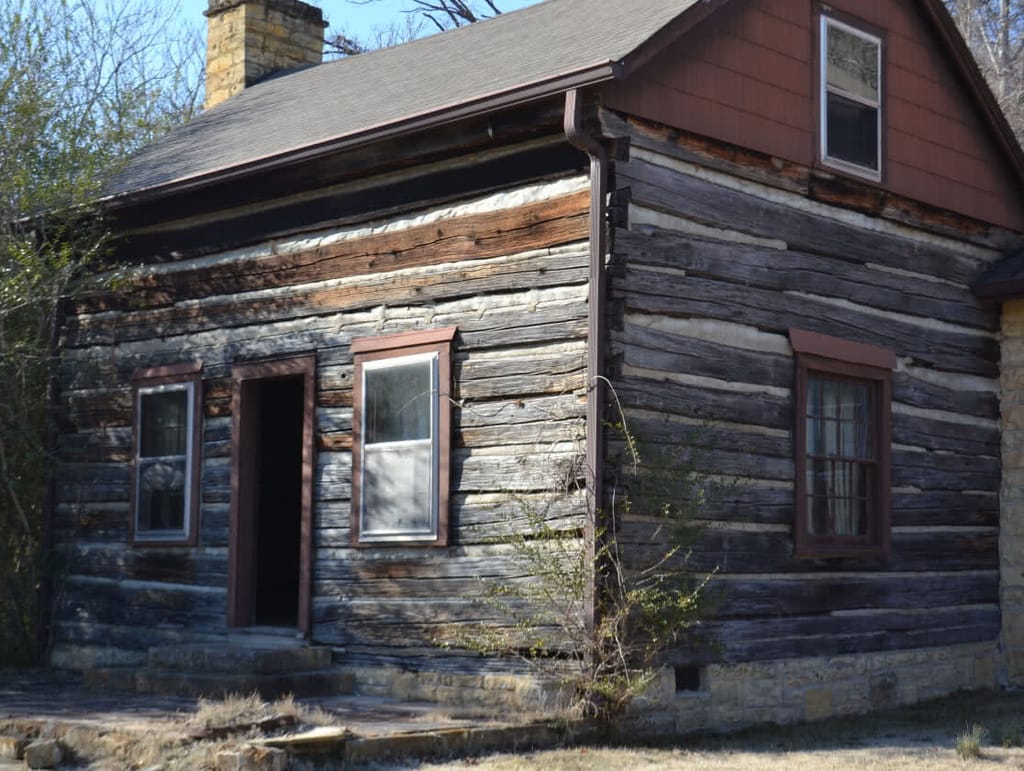
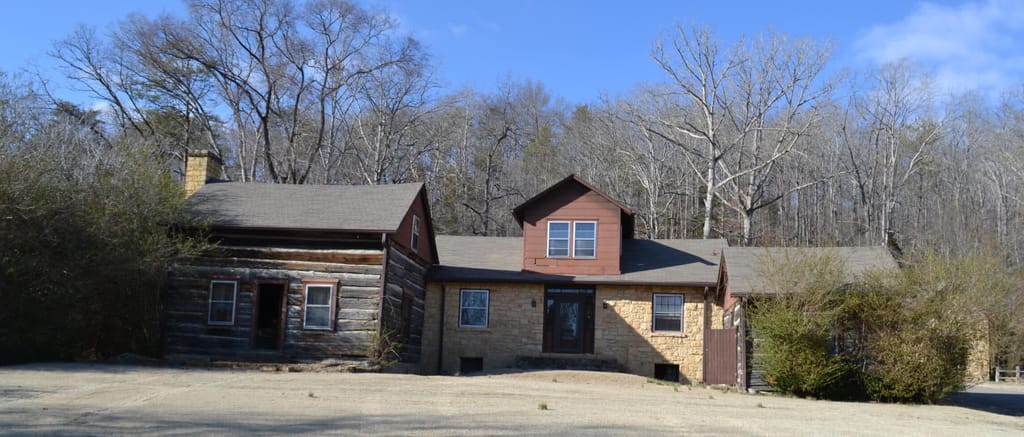
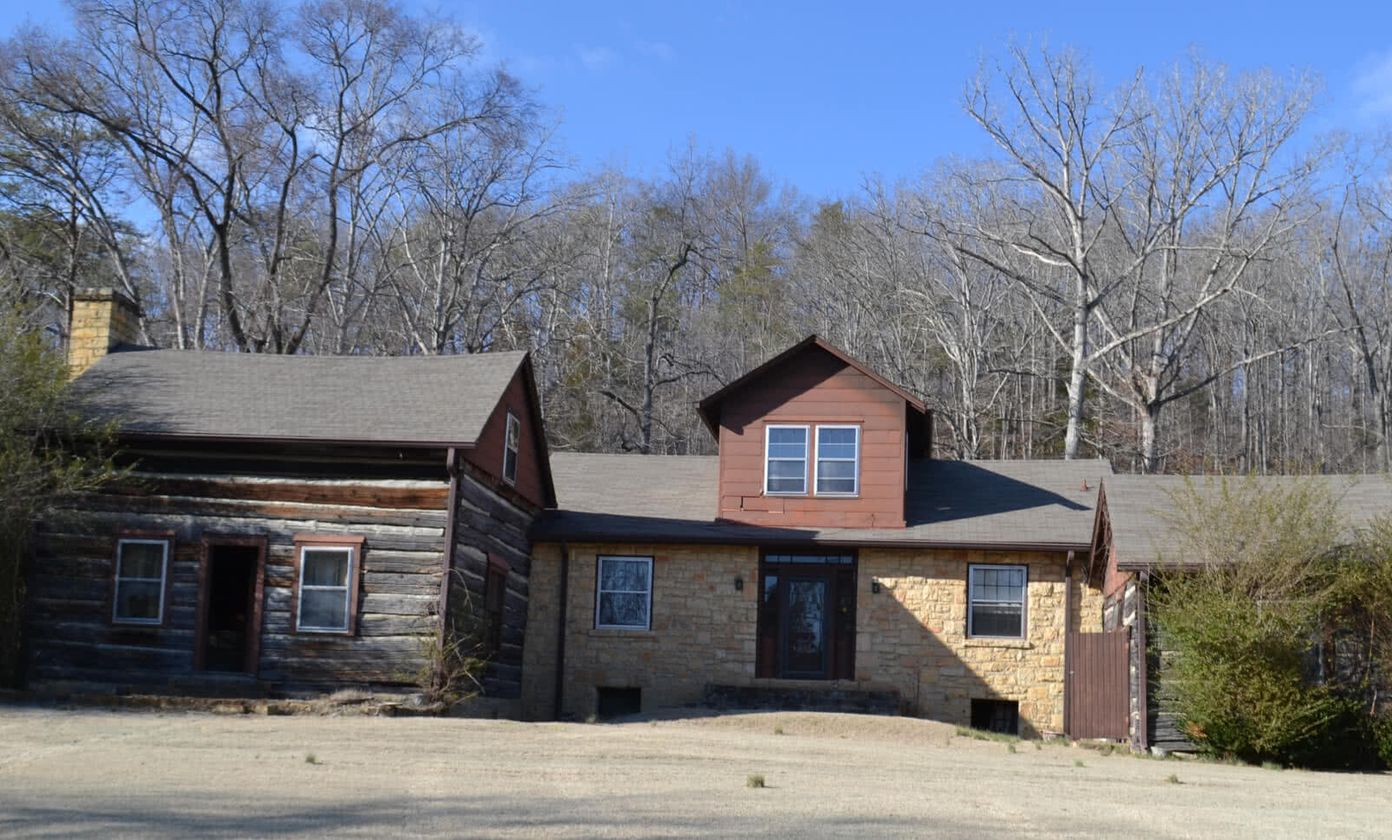
The most obvious evidence of prior human habitation at The Golf Club of Tennessee is the remaining piece of the cabin overlooking Hole #13. The cabin consisted of three structures and two outbuildings, built and rebuilt over the last one hundred-fifty years. During its life, the cabin and its associated outbuildings, like the land itself, has hosted many owners and activities. The cabin was originally assembled from three separate structures, one of balloon frame and stone construction and the other two of chestnut log construction that were connected at the corners, however, they do not share walls and one cannot move from structure to structure without going out of doors. The stone portion of the cabin has a wood frame with native stone siding. The building was likely built in the 1920s because there was little money for stone construction during the Great Depression. It is very likely that the stone portion of the cabin was built around a pre-existing chimney that remained from an earlier house that was likely a log structure. Also, there is a poured concrete sidewalk leading to the rear of the stone structure in which someone carved “AL” and “1939”.
There are two outbuildings associated with the cabin. One is a two-car garage built from materials similar to the stone structure. The other is an underground cellar located approximately 75 feet behind the house in the woods. The sizes of the garage doors indicate early 20th century construction and are not large enough to accommodate modern automobiles. At one end of the garage, there is a stone walled room that could have served as a smokehouse. The cellar is built into the hillside, constructed of concrete, and is approximately 6 foot square, larger than that which is usually associated with food storage. Also, it has a vented roof. It is possible that the cellar was built to conceal illegal whiskey production, which could explain its size and location.
The uses for the cabin are largely unclear. Although the land was owned by the E. F. and Mollie L. P’Pool during the period when it was built, their descendants do not recall them living or doing business in that area and claimed no knowledge of bootlegging activities. Local resident Eva Lee, however, remembered the cabin in her March 1993 reminiscence about the honky tonks of Kingston Springs. In her writing Ms. Lee names fourteen establishments in Kingston Springs and Pegram that were known for their liquor sales. She describes an unnamed house with a large and small log house in front where, “I think they sold bootleg whiskey in the early 1930s,” Lee’s physical description of the property is a match for the Cabin.
There are no written records to indicate that the cabin housed a bootlegging operation. This is not unusual because illegal establishments rarely maintain records of their illicit activities or if those records are kept, they are seldom donated to state or local archives. Court records do not show that this site was ever raided or that any arrests were made on the property. The cabin’s remote location, concealed from public view and away from the towns of Kingston Springs and Pegram, likely contributed to the Prohibition era activities remaining anonymous.
When the Club first opened, the Cabin was used as offices for the maintenance team. Once the maintenance facility was built off South Harpeth Road, the Cabin was used to house The Club’s Assistant Maintenance Supervisor. In 2015 some flooding in the cellar caused extensive water damage requiring demolition for most of the structure leaving only the smaller wooden shed. In 2015, The Club’s culinary team utilized the shed and the area around it for a garden and to keep bees. The honey produced was called “Back 9 Honey” and was sold in the Golf Shop. Today only one section of the structure remains and sits vacant overlooking Hole #13 to honor the history of the land.